
Claude Code or the chat? The rule I use to pick one
Both run on the same model, but they do different jobs. When I open each one, what goes wrong when I mix them up and the questions I ask to decide.
People ask me a lot which of the two I use. I use both, every day, and the choice is almost never hard.
I follow one rule. If the work touches files, runs commands or needs testing, I open Claude Code, and if it's for thinking, writing or deciding, I open the chat. I think most of the frustration I see with AI comes from using one where the other belongs.
The chat is for thinking
In the chat I talk things through. I test an argument, ask for the case against a decision and sort out an idea that's still messy, and the conversation itself is what I wanted.
What I don't do in the chat is project code, because the chat can't see my repository. It answers with a generic snippet, I copy it, paste it, find out the function has a different name, go back, explain and copy again, and every round trip loses a bit of context.
Claude Code is for doing
In Claude Code the agent works inside the project folder. It reads the files, runs the command, sees the error and fixes it, and what I get at the end is the changed file and the test passing.
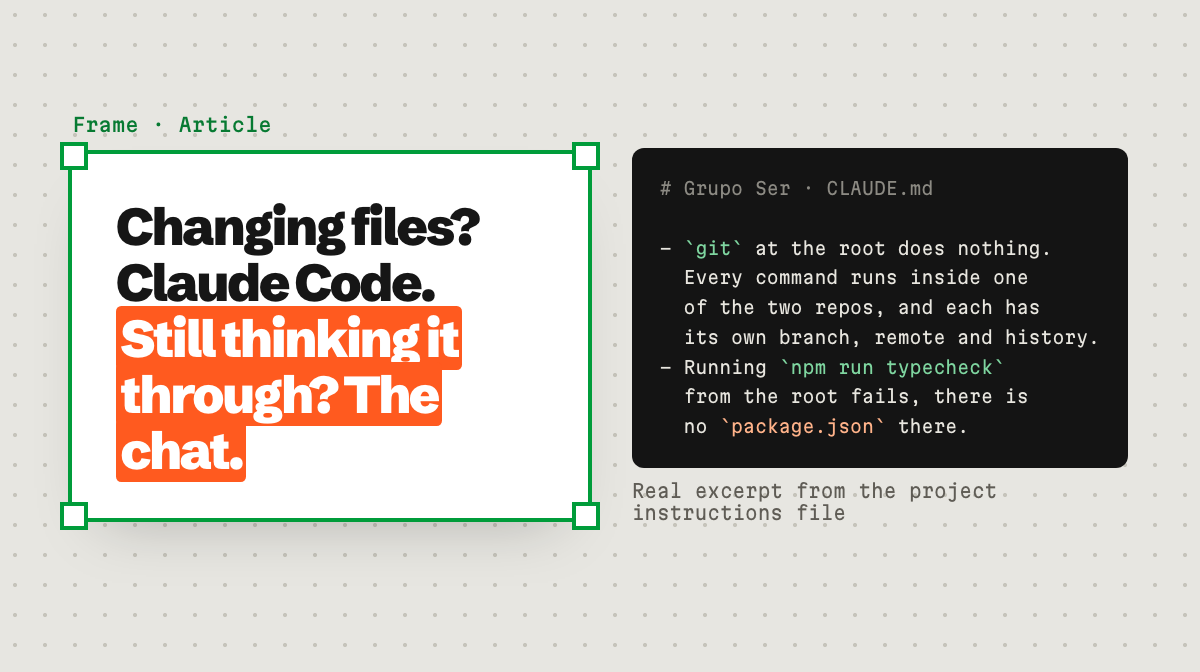
The clearest example is Grupo Ser. It's three separate repositories opened in a single VS Code workspace: the site in Next.js, the back office in Strapi and a tester in Playwright. So the agent doesn't get lost, each one has a CLAUDE.md, which is the instructions file the agent reads, and the root has another one explaining how the pieces fit together. Here's a real excerpt:
- `git` at the root does nothing. Every command runs inside one of the two
  repos, and each has its own branch, remote and history.
- Running `npm run typecheck` from the root fails, there is no
  `package.json` there.
That's the kind of thing I could never explain in a chat with every request. I write it once and every agent that opens the project already knows it.
And what closes out the work is something only Claude Code does, which is running the checks. On Grupo Ser that's 117 unit tests and 9 end-to-end tests, the ones that open the site in a browser and click around like a user, plus the typecheck, which checks the types in the code. The agent changes the code and runs everything before handing it to me, and if something broke, it sees the same error I would.
What goes wrong when you swap them
Code in the chat turns into endless copy and paste, with the model guessing what your project looks like on the inside.
Thinking in Claude Code is the opposite mistake, and I think it costs more. The agent is built to act, so if I haven't decided what I want yet, it decides for me and starts writing files. That's why I saved a rule in the memory of my creative agents: before a long render or a big edit, the agent shows me a preview, like a frame from the video or the layout, and waits for my OK.
How I decide
When I have to pick, I ask myself three questions:
- Is it going to change a file? Claude Code.
- Do I need to run something to know if it's right? Claude Code.
- Do I still not know what I want? The chat, until I know, and then Claude Code with the decision written down.