
I built an agency of AI agents, and here's where it still needed a person
Six agents that plan, design, review and publish posts on their own, a dashboard so I can watch it all happen, and the parts that stayed my job.
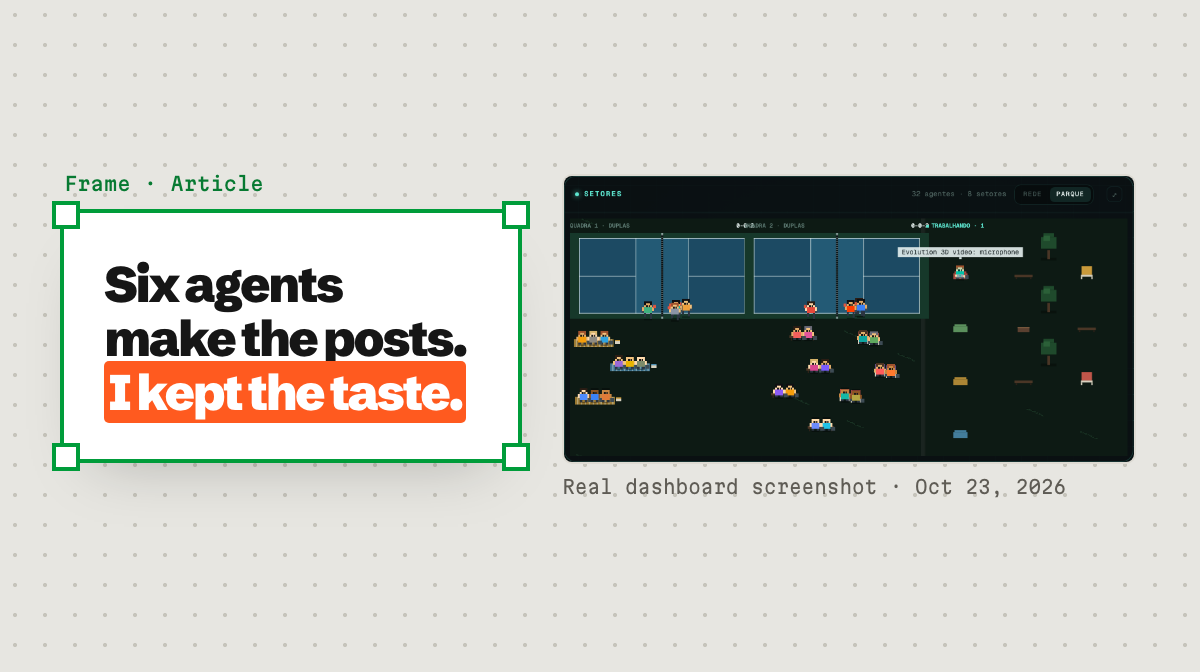
In October I set up a creative team made of AI agents, where each agent has a role, a written manual and a folder. I make the request, and they plan the posts, design them, review them and publish them on Facebook and Instagram.
In three days the team published 39 posts, and 17 of them also went out as stories. That part was good, but what I learned the most from was where it still needed me.
How it works
There are six desks, one per agent:
- Planner. Looks for tech and AI news online and writes ideas into the client's backlog.
- Editor. Picks the ideas, decides the format and writes the text on the image and the caption.
- Art director. Generates the art for the whole batch at once.
- Visual reviewer. Looks at the art the way it's going to show up in the feed, and approves it or sends it back.
- Content reviewer. Checks facts, the caption and Meta's ad policies, and fixes the caption but never the art.
- Publisher. Only steps in when publishing gets stuck.
What holds it all together is a simple rule: the folder is the status. A post moves from folder to folder, and only one command line tool can move it.
producao/<data>/<cliente>/
  1-pauta/  2-arte/  3-revisao/  4-final/  5-publicado/  9-cortado/
If the art gets rejected, the post goes back to the art folder with the reason written down, and if it gets rejected twice, it goes to 9-cortado, which means cut. In other words, no agent has to remember anything, it just reads the folder.
The first day
The first round took over an hour to make five posts, all five looked the same, and the reviewer kept rejecting details nobody sees on a phone.
So I changed three things. Each agent started working on a batch of five posts instead of one at a time. Agents that don't depend on each other started running together, in waves, so the two reviewers look at batch 1 while the art director is already making batch 2. And the reviewer got a rule: it only rejects what shows up in the feed or what's actually wrong, and its personal taste becomes a note.
The next day, 20 posts went out in about an hour of production.
The dashboard
An agent working in the terminal is a wall of text, and I wanted to see the team from a distance, like looking into an office from the doorway.
So I built a dashboard where each agent is a little character in a pixel art park. The ones who are free play doubles pickleball, with the real rules of the game, and when one gets called, it leaves the court, sits down, opens its laptop, and a speech bubble says what it's doing.
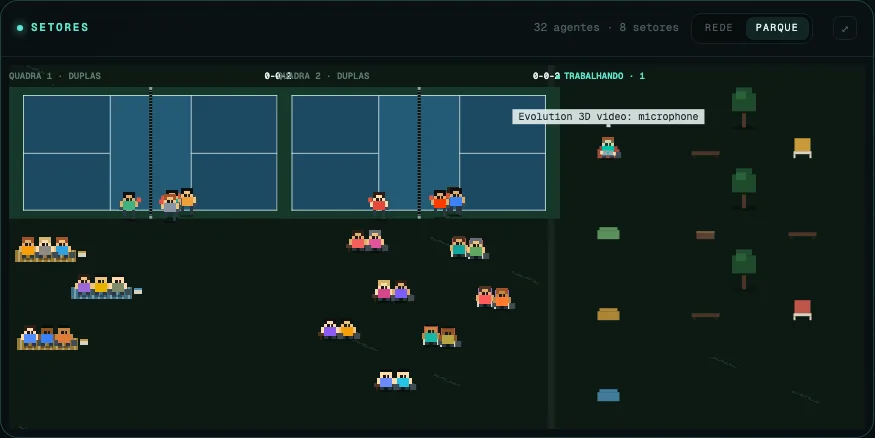
It might look like a toy, but I glance at it and I know who's working, who's idle and where the queue got stuck. When an agent has a question, it lands in an inbox on the dashboard, and my answer goes back to it. Today the same screen shows more than 30 agents, for video, websites and other projects of mine.
Where it needed a person
The first thing was taste. The reviewers approved ten posts for two clients and I cut all ten, because they were correct, with no mistakes at all, but they looked like templates. AI checks whether something is wrong, but whether it's boring is something I have to see. I also set the visual style for each client myself, by looking at posts and choosing.
Then there was money. Every image costs credits, and on the second day, tests nobody was keeping an eye on ate up the whole month's credits. Now the team splits the balance across the days left and never goes over the daily limit, and that rule came from a mistake I made.
And another thing, what goes out. An organic post that passes both reviews goes out on its own, but ads, emails and anything else, I'm the one who posts them. There's also a pause button on the dashboard that stops everything.
I think what makes a team of agents work is that each one has a small job, a written manual and a clear place to deliver it, and that's more management than prompting. The part I don't hand off is the same as when I was an art director: saying what's good, cutting what's only correct, and owning what goes public.