
Why I work with AI agents, and why it isn't about speed
What I get from working with AI agents is getting several things done in parallel. The rules I wrote so that doesn't turn into a mess, and what I still don't leave to them.
When I tell people I work with AI agents, the question I get is how much time I save, and I think that's the wrong question.
One agent on its own isn't much faster than me with a good editor, and sometimes it's slower, because I have to read what it did. What I get is several pieces of work moving at the same time while I review. In other words, working with agents changed my role more than my speed: today I write less code and more rules, I split up the work and I review, which is closer to leading a team than to typing.
One thing at a time
For a while, the rule in my repository was to do one thing at a time. It was safe, but it was slow in a silly way, because research waited for code, code waited for review, and I waited for everyone.
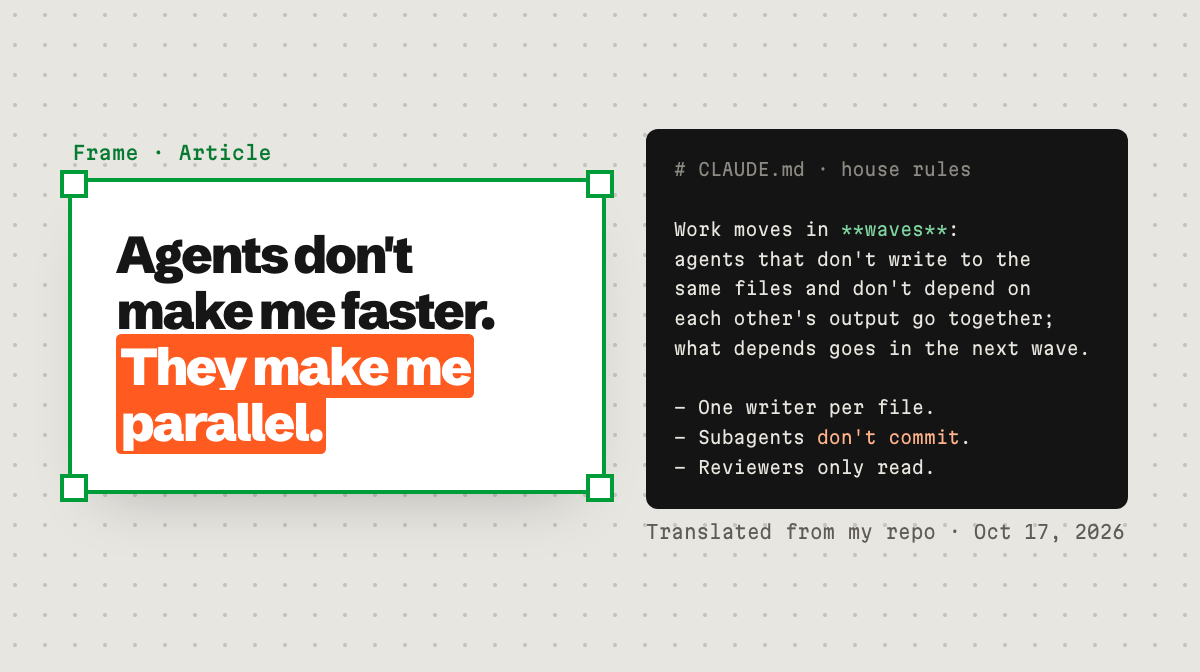
On October 17, 2026 I changed the rule, and today it's in the instructions file every agent reads before it starts. It's in Portuguese, and it says work moves in waves: agents that don't write to the same files and don't depend on each other's output go out together, in a single message, and whatever depends on them goes in the next wave.
O trabalho anda em **ondas**: agentes que não escrevem nos mesmos
arquivos e não dependem da saída um do outro saem juntos, numa
mensagem só; o que depende vai na onda seguinte.
So the question I ask myself now is what can run at the same time.
The rules that keep parallel work from turning into a mess
Parallel work with no rules is five people editing the same document, so I wrote a few.
One writer per file. In the same wave, two agents never touch the same file, and a shared config file has only one owner.
Agents don't commit. Each one delivers its work and stops. Whoever orchestrated the wave checks each agent's diff and makes the commits in order, one per task. That way the history stays readable and I know where every line came from.
Reviewers only read. Whoever reviews doesn't edit, and that's why it can run alongside whoever is already making the next batch without stepping on anyone.
Code in the same repository, each agent in its own worktree. When two agents write code in the same project, each one works in an isolated copy. Conflicts show up at the merge, where I can see them, and not in the middle of the work.
My job search
The best example is my job search. While one agent researched job openings, others audited my website and my resume. The research ended with 70 openings ranked in a spreadsheet, and the audits turned into two lists of fixes.
In a queue, each task would have waited for the one before it. In parallel, my job was to read, cut what was wrong and decide.
And this works for content too. This article was written in the same wave as other ones, each agent in its own folder, and none of them published anything on its own.
What I don't leave to them
Publishing. Anything with my name on it, ads and emails don't go out without my approval.
Spending. Image and video generation credits only get spent when I say so. Before a wave that generates images, the cost for every agent in it gets added up and checked against the balance.
Shipping to production. Deploys are mine. The agent leaves it ready and tested, but pushing is my call.
Reading the diff. Agents make mistakes with confidence, and parallel work only works because someone reads everything at the end, and that someone is me.